


Gum Graft Cost and Recovery: What to Expect in Oakville
Learn what affects gum graft cost, how the procedure works and what gum graft recovery looks like week by week, from our periodontal team in Oakville.
A breakthrough case study by Dr. Peter A. Taylor demonstrating advanced implant restoration techniques.
Originally published in the Journal of the Canadian Dental Association
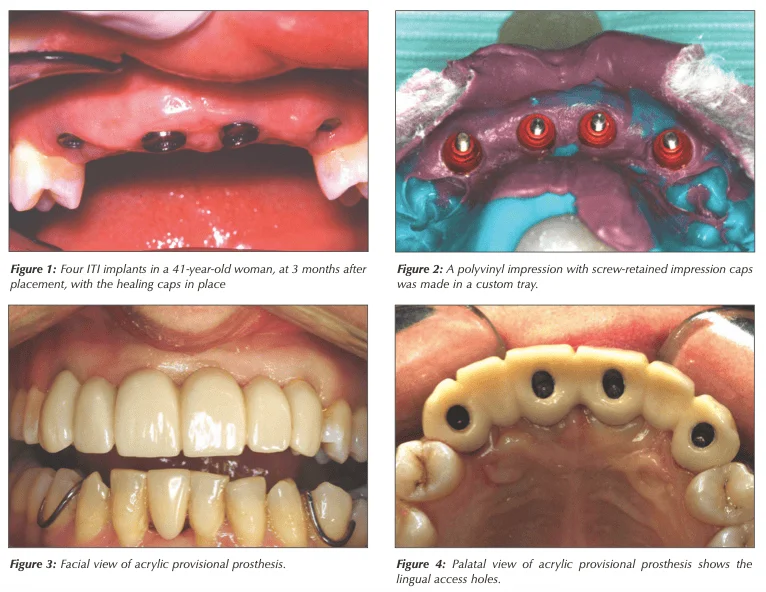
A screw-retained implant restoration is a crown or bridge held onto dental implants with a small screw rather than dental cement. Because it can be unscrewed, your dentist can remove it later for cleaning, repairs or adjustments without cutting it off or disturbing the implants. This “retrievability” can make long-term maintenance simpler, especially for bridges that span several implants.
When people think about dental implants, they usually focus on the implant itself, the small titanium post in the jawbone. But the way the visible teeth are attached to that post matters a great deal over the years. This article explains the two main ways implant teeth are attached, what a retrievable prosthesis is, the role of the abutment system, and how your dentist decides which approach suits you.
An implant tooth has three main parts:
“Prosthesis” simply means a replacement for a missing body part. In dentistry, it refers to any replacement teeth, from a single crown to a full arch. The question this article focuses on is how that prosthesis is fixed to the abutment, and whether it can be taken off again later.
A cement-retained crown is glued onto the abutment, much like a crown on a natural tooth. The crown has no access hole, so its surface is continuous, which some people prefer for appearance. Cemented crowns are widely used and can work very well.
There are some trade-offs to be aware of:
A screw-retained crown or bridge is attached with a small screw that passes through the restoration into the abutment or implant. The screw access hole is then sealed with a tooth-coloured filling material. To remove the restoration, your dentist opens the access hole and unscrews it.
The main benefits are:
The trade-off is the access hole. On back teeth, it usually sits on the biting surface and is filled to match the tooth. On front teeth, its position depends on the angle of the implant, which is why careful planning matters.
Implant restorations are exposed to daily chewing forces for many years. Even with excellent care, some maintenance is normal over time. A retrievable restoration can make that maintenance more straightforward.
The gum and bone around implants can become inflamed, a condition similar to gum disease. If your dentist or periodontist needs better access to clean around the implants or check the tissues, a screw-retained bridge can be removed, cleaned and replaced.
Occasionally, the screw that holds an abutment or crown in place can loosen. With a screw-retained design, your dentist can reach it directly, tighten or replace it, and reseal the access hole.
Porcelain can chip, especially in people who clench or grind. A retrievable bridge can be sent to the laboratory for repair rather than remade from scratch. This can save time and cost compared with replacing a cemented bridge.
If a new implant is added nearby, or the design of the restoration needs to change, being able to remove the existing work gives your dentist more flexibility.
The abutment is the link between the implant and the visible teeth, and implant manufacturers make several abutment designs for different situations. Some are straight, some angled, and some are made specifically for screw-retained work.
One example of this approach is restoring the upper front teeth with the ITI implant system and its Syn-Octa abutments with a transverse screw (the “TS” in Syn-Octa TS) to restore the upper front teeth. Instead of a screw entering through the biting edge or front of the tooth, a transverse screw enters from the side, through the tongue-facing (lingual) surface. This kept the access holes on the back of the teeth, where they are not visible when smiling, while keeping the multi-unit prosthesis retrievable.
The same case report described several careful steps that are common in implant work generally:
Abutment systems and screw designs have continued to evolve, and today there are several ways to achieve a retrievable restoration, including angled screw channels. The specific components your dentist chooses depend on the implant system, the angle of the implants and the position of the teeth. The principle stays the same: plan the restoration so that it can be maintained over the long term.
There is no single right answer for every patient. Your dentist will consider your mouth, your bite and your goals. Screw retention is often considered in these situations:
A cemented crown may still be a reasonable choice in some situations, for example when the implant angle would place a screw hole in a visible spot and an alternative design is not practical. Your dentist will explain the options and why one is recommended.
For most patients, screw-retained restorations follow the usual implant steps:
Afterwards, regular checkups and cleanings allow your dentist to check the screws, the bite and the gums.
Retrievability helps with repairs, but day-to-day care is still what keeps implants healthy:
Shore Side Dentistry is on Lakeshore Road East in downtown Oakville and has cared for patients since 1990, including many from Old Oakville, Bronte Village and Burlington. Dr. Peter Taylor focuses on restorative, implant and prosthetic dentistry. He is a Fellow of the Canadian Academy of Restorative Dentistry and Prosthodontics and an adjunct clinical professor and lecturer in prosthodontics at the Schulich School of Medicine & Dentistry at Western. Dr. Tina Kokosis, our certified specialist in periodontics, looks after gum health and implant care. Learn more about our dental implant services or Dr. Taylor’s background.
Neither is right for every case. Screw-retained crowns are easier to remove and avoid cement below the gum, while cemented crowns have no access hole. Your dentist will recommend one based on the implant angle, the position of the tooth and your maintenance needs.
The access hole is sealed with tooth-coloured material. On back teeth it is on the chewing surface, and on front teeth it is usually planned to sit on the tongue side, so it is generally hard to see in everyday life.
It can happen, usually because a screw has loosened. If an implant crown feels loose, call your dentist rather than waiting. With a screw-retained design, the screw can often be tightened or replaced at a short visit.
It varies. Many implant restorations need little more than regular checkups and cleanings for years, while people who grind or have gum concerns may need more frequent attention. Your dentist will suggest a recall schedule that fits you.
You cannot remove them yourself, but they are commonly screw-retained so your dentist can take them off for cleaning, checks and repairs. This is different from a snap-in implant denture, which you remove daily.
If you have questions about implant crowns, bridges or an existing restoration that needs attention, we are happy to take a look. Book a visit or call us at 905-842-2364.
Please note: This article is general information to help you understand common dental topics. It is not a diagnosis or a substitute for an exam. Every mouth is different, so please book a visit or call 905-842-2364 so one of our dentists can look at your situation and talk through your options.
Clinical Note: This case was published in the Journal of the Canadian Dental Association, demonstrating Dr. Taylor’s commitment to advancing dental techniques and sharing knowledge with the professional community.
Click here to read the complete clinical case study with detailed techniques and photographs in the original CDA publication.

Care for the whole family, from young children to grandparents.

Cleanings, fluoride, sealants and habits that help prevent problems.
Regular checkups to catch problems early, when they are easier to treat.
Shore Side Dentistry has cared for Oakville families since 1990. Our four dentists, including a certified specialist in periodontics, work together in one office on Lakeshore Road East.
Our office at 345 Lakeshore Rd E #401 in downtown Oakville welcomes patients from across Halton, including Old Oakville, Glen Abbey, River Oaks, Joshua Creek and nearby Mississauga.
Our home neighbourhood in downtown Oakville, steps from Lakeshore Road shops and the waterfront.
A short drive along Lakeshore Road for families in Bronte and west Oakville.
An easy trip along the QEW or Lakeshore Road for patients coming from Burlington.
A straight drive south on Trafalgar Road for families in Milton.
Learn what affects gum graft cost, how the procedure works and what gum graft recovery looks like week by week, from our periodontal team in Oakville.

Comparing a dental implant vs bridge for a missing tooth: how each works, pros and cons, timing, cost factors and how our Oakville team helps you choose.