


Gum Graft Cost and Recovery: What to Expect in Oakville
Learn what affects gum graft cost, how the procedure works and what gum graft recovery looks like week by week, from our periodontal team in Oakville.
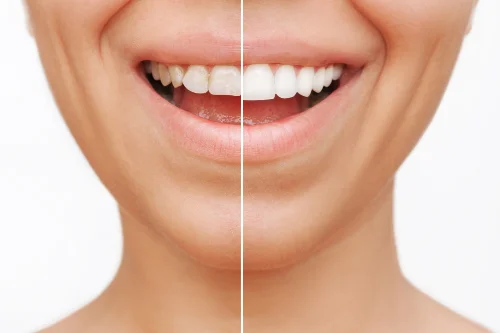
Smile design is the process of planning cosmetic and restorative changes to your teeth before any treatment begins. Your dentist uses photos, digital scans and an examination to look at tooth shape, proportions, colour and gum line in relation to your face. The result is a personalized plan, often with a preview, that may combine treatments such as whitening, Invisalign, veneers or crowns.
Many people know they would like to change something about their smile but are not sure what is possible or where to begin. Smile design gives that process structure. Instead of treating one tooth at a time, your dentist looks at how all the parts of your smile work together, then builds a plan that fits your goals, your oral health and your budget. This article explains how it works, what happens at each step and what to realistically expect.
Smile design is a planning approach rather than a single treatment. It brings together information about your teeth, gums, bite and facial features to decide which changes would look balanced and natural for you.
A good plan considers more than appearance. Teeth also need to function well: your bite should be comfortable, your gums should be healthy, and any restorations should be designed to last. That is why smile design starts with a full examination, not just a conversation about colour or shape.
Smile design can be as simple as whitening and reshaping one or two edges, or it can involve several treatments over months. The plan is built around you, and you decide how far you want to go.
Your first visit is about understanding what you would like to change and what is happening in your mouth today.
Your dentist will ask what you notice when you look at your smile. Common concerns include discolouration, chips, gaps, crowding, uneven edges, short or worn teeth, old fillings or crowns that no longer match, and a gummy smile. It helps to bring photos of smiles you like, or of your own smile from years ago, to show what appeals to you.
A dental exam checks for cavities, gum disease, worn teeth and bite problems. These need attention before cosmetic work, because placing veneers or crowns on unhealthy teeth or gums can lead to problems later. Digital X-rays help your dentist see what is happening below the surface.
Once your dentist understands your goals and your oral health, they can describe the options available, how long each takes and what is involved. Many plans can be staged over time if that suits your budget or schedule.
Good planning depends on good records. At Shore Side Dentistry, these may include:
These records also serve as a “before” reference, so you can compare your progress over time.
Smile design uses a number of guidelines to help create a balanced result. They are starting points, not strict rules, because every face is different.
The two upper front teeth are usually the focal point of a smile. Their width relative to their length, and how they relate in size to the teeth next to them, affect whether a smile looks balanced. Teeth that are too short or too square can look worn, while teeth that are too long can look unnatural.
Your dentist looks at how the edges of your upper teeth follow the curve of your lower lip when you smile, and at the centre line of your teeth relative to your face. Exact symmetry is rare in nature, and small differences often look more natural.
The amount of gum that shows, and how even the gum line is across your front teeth, has a big effect on how your smile looks. Uneven gum levels can make teeth appear different lengths even if they are not.
Choosing a shade involves more than picking the whitest colour. A shade that suits your skin tone, the whites of your eyes and your remaining natural teeth usually looks more natural. If you plan to whiten, it is done first so any restorations can be matched to your new colour.
A smile design plan may use one treatment or several, often in a specific order.
Professional whitening can lighten natural teeth. It does not change the colour of existing fillings, crowns or veneers, which is why it is usually done before any new restorations.
If teeth are crowded, spaced or rotated, straightening them with Invisalign clear aligners may be a conservative way to improve the smile, because it keeps your natural teeth intact. Straightening first can also reduce how much tooth structure needs to be removed if veneers or crowns are planned later. As a general range, not a quote, Invisalign treatment is about $3,000 to $8,000; a consultation is needed.
Tooth-coloured composite can repair small chips, close small gaps and refine the shape of a tooth, often in one visit.
Thin porcelain shells bonded to the front of the teeth can change shape, length and colour. As a general range, not a quote, porcelain veneers are about $1,000 to $2,500 per tooth. Learn more on our porcelain veneers page.
For teeth that are weak, heavily filled or root-canal treated, crowns that cover the whole tooth can restore strength and appearance.
Reshaping the gum line can even out uneven gum levels or reduce a gummy smile. In some cases this is done with radiosurgery. When the plan involves the gums, our certified specialist in periodontics, Dr. Tina Kokosis, may be involved.
If teeth are missing, a smile design plan may include dental implants, bridges or dentures so the new teeth fit the overall design.
A useful part of smile design is being able to see a proposed change before committing to it. Depending on the treatment, a preview may take the form of:
Previews give you a chance to give feedback. You might want teeth slightly shorter, a little rounder or a different shade. Changes are much easier to make at this stage than after the final restorations are placed.
Smile design can make a meaningful difference, but it helps to go in with realistic expectations:
Your dentist will be honest about what is likely possible for you and what trade-offs each option involves.
Shore Side Dentistry is on Lakeshore Road East in downtown Oakville and has served the community since 1990. Patients visit us from Old Oakville, Bronte Village and River Oaks, as well as Burlington. Dr. Peter Taylor focuses on restorative and prosthetic dentistry and is a Fellow of the Canadian Academy of Restorative Dentistry and Prosthodontics. Visit our cosmetic dentistry page to learn more about the treatments we offer.
A smile makeover is a combination of cosmetic and restorative treatments planned together to improve the appearance of your smile. Smile design is the planning process behind it. A makeover may be as simple as whitening and bonding or may include Invisalign, veneers, crowns or gum contouring.
The planning itself usually takes one or two visits. Treatment time depends on what is included: whitening and bonding can be done fairly quickly, while plans involving Invisalign, gum treatment or several veneers can take months.
Often, yes. Depending on the treatment, your dentist may offer a digital simulation, a wax-up or a trial smile placed temporarily over your teeth. These are previews, so the final result may differ slightly.
Treatments done mainly for appearance, such as veneers and whitening, are usually considered cosmetic and are not covered by many plans. Parts of a plan that treat decay, broken teeth or gum disease may be covered. We can send a pre-determination to your insurer.
The focus is usually on the teeth that show when you smile, but your dentist also considers your bite and back teeth so the result functions well.
If you would like to explore what is possible for your smile, a consultation is the first step. Book a visit or call us at 905-842-2364.
Please note: This article is general information to help you understand common dental topics. It is not a diagnosis or a substitute for an exam. Every mouth is different, so please book a visit or call 905-842-2364 so one of our dentists can look at your situation and talk through your options.

Care for the whole family, from young children to grandparents.

Cleanings, fluoride, sealants and habits that help prevent problems.
Regular checkups to catch problems early, when they are easier to treat.
Shore Side Dentistry has cared for Oakville families since 1990. Our four dentists, including a certified specialist in periodontics, work together in one office on Lakeshore Road East.
Our office at 345 Lakeshore Rd E #401 in downtown Oakville welcomes patients from across Halton, including Old Oakville, Glen Abbey, River Oaks, Joshua Creek and nearby Mississauga.
Our home neighbourhood in downtown Oakville, steps from Lakeshore Road shops and the waterfront.
A short drive along Lakeshore Road for families in Bronte and west Oakville.
An easy trip along the QEW or Lakeshore Road for patients coming from Burlington.
A straight drive south on Trafalgar Road for families in Milton.
Learn what affects gum graft cost, how the procedure works and what gum graft recovery looks like week by week, from our periodontal team in Oakville.

Comparing a dental implant vs bridge for a missing tooth: how each works, pros and cons, timing, cost factors and how our Oakville team helps you choose.